As someone who has worked for a while now helping others learn about effective use of educational technology for teaching and learning, I have seen a number of reflective frameworks, but none of them really hit the spot with me. I just want a framework that will help focus us on whether or not that use of technology, or any tool or resource for that mattter, is helping us in our support of truly effective learning.
I believe there should always be at least 3 main areas of focus: is the tool supporting strong pedagogy, are the learners using it in an active as opposed to passive way, and is the tool removing barriers to learning while also providing opportunities that may not have been there before. I try to go into a little bit more depth below but this is a work in progress that I hope to keep improving. Either way, it can help us focus our use of edtech, and any tool for that matter, so that we can be doing the work that we really want to be doing in the classroom.
The Three Pillars of Effective Technology Integration
Before incorporating a technology tool or digital resource into your lesson, consider the following three pillars and the reflective questions within each.
1. Pedagogical Purpose: The “Why” Behind the Tech
This component, drawing from the heart of the TPACK framework, emphasizes that technology is a tool in service of a specific learning goal, not the goal itself. It’s about the intentional intersection of Content Knowledge (CK), Pedagogical Knowledge (PK), and Technological Knowledge (TK).
Reflective Questions for the Teacher:
Content & Pedagogy: What specific learning objective will this technology help my students achieve? Does the technology enhance my instructional strategy for this particular concept?
Alignment: Is this the most effective way to learn this content, or is there a non-digital method that would be more impactful?
Accessibility (UDL): How does this technology help to remove barriers for students with varied abilities and learning preferences? Does it provide multiple means of representation, engagement, or expression? For example, does it offer text-to-speech, customizable displays, or various ways for students to demonstrate their understanding?
2. Student Interaction: From Passive to Active Learning
This pillar synthesizes the core ideas of the Triple E Framework (Engage, Enhance, Extend) and the transformative levels of the SAMR model (Modification and Redefinition). The focus shifts from what the teacher is doing with technology to what the students are actively doing and creating.
Reflective Questions for the Teacher:
Engagement: Does the technology foster active, “minds-on” learning rather than passive consumption of information? Are students simply watching or are they creating, collaborating, and problem-solving?
Enhancement & Modification: Does the technology add value to the learning task by providing features that a traditional tool could not? Does it allow for a significant redesign of the task, pushing students towards higher-order thinking skills?
Extension (UDL): Does the technology help learners connect what they are learning to the real world? Does it provide opportunities for authentic tasks and collaboration beyond the classroom walls, offering flexible learning pathways?
3. Transformative Impact: Redefining What’s Possible
This component challenges educators to think beyond simple substitution and consider how technology can create entirely new learning opportunities that would be impossible without it. This is where technology has the most profound impact on student learning and accessibility.
Reflective Questions for the Teacher:
Redefinition: Does the technology allow for the creation of new tasks that were previously inconceivable? Are students, for example, collaborating with experts or peers globally, publishing their work for an authentic audience, or creating interactive models to demonstrate complex systems?
Empowerment (UDL): Does the technology empower students to take ownership of their learning, make choices, and pursue their own questions? Does it provide tools that allow students to express their knowledge and skills in diverse and personalized ways?
Future-Ready Skills: Is the use of technology helping to develop critical skills such as creativity, critical thinking, communication, and collaboration?
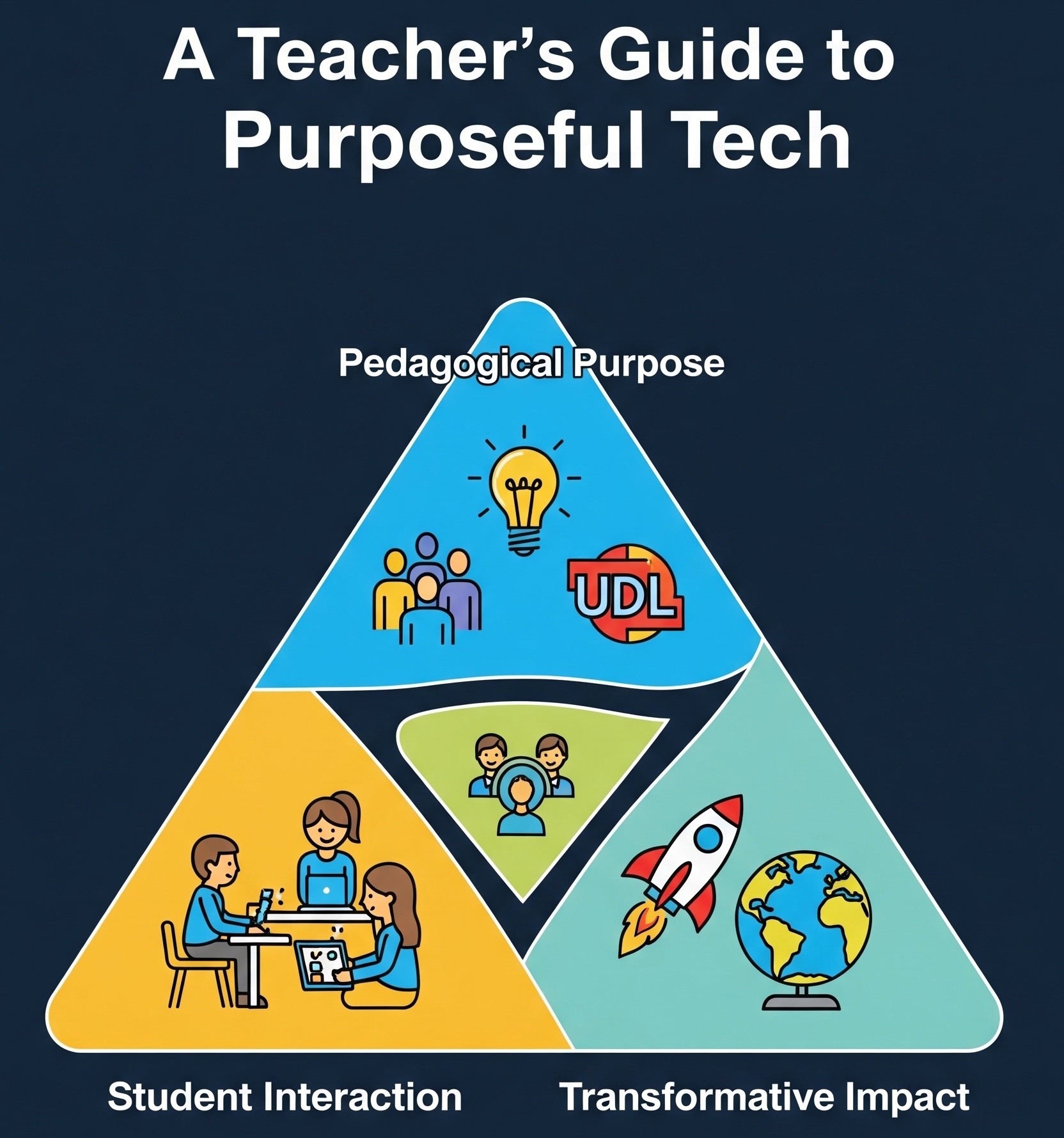
(This image was created through the use of AI)
 Donovanscience